
adjunction
Meanings


Examples :
संलग्नता
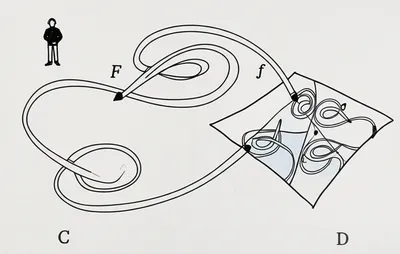
Given a pair of categories \mathcal{C} and \mathcal{D}: an anti-parallel pair of functors F:\mathcal{C}\rightarrow \mathcal{D} and G:\mathcal{D}\rightarrow \mathcal{C} and a natural transformation \eta:\mbox{id}C \rightarrow GF called “unit” such that for any object A \in \mathcal{C}, for any object B \in \mathcal{D}, and for any morphism f:A\rightarrow GB, there is a unique morphism g:FA\rightarrow B such that Gg \circ \etaA = f. (Note: there is another natural transformation called “counit” as well but its existence may be derived by theorem.) The pair of functors express a similarity between the pair of categories which is weaker than that of an equivalence of categories.
Examples :
"The professor explained the concept of adjunction between two mathematical structures using examples from group theory and linear algebra, showing how it establishes a formal connection between them. "
प्रोफेसर ने समूह सिद्धांत और रैखिक बीजगणित के उदाहरणों का उपयोग करते हुए दो गणितीय संरचनाओं के बीच संलग्नता की अवधारणा को समझाया, यह दिखाते हुए कि यह उनके बीच एक औपचारिक संबंध कैसे स्थापित करता है।
Related Words

connection noun
/kəˈnɛkʃən/
संबंध, जुड़ाव
"The connection between the two classrooms was established by installing a new phone line. "
दो कक्षाओं के बीच संबंध एक नई फोन लाइन स्थापित करके स्थापित किया गया था।

transformation noun
/ˌtɹæns.fə(ɹ)ˈmeɪ.ʃən/ /ˌtɹæns.fɔɹˈmeɪ.ʃən/
परिवर्तन, रूपांतरण
"The transformation of the classroom from a noisy space to a quiet learning environment was remarkable. "
शोरगुल वाले स्थान से शांत सीखने के माहौल में कक्षा का परिवर्तन उल्लेखनीय था।









establishes verb
/ɪˈstæblɪʃɪz/ /əˈstæblɪʃɪz/
स्थापित करना, पुष्टि करना
कंपनी एक पेशेवर कार्य वातावरण सुनिश्चित करने के लिए कर्मचारियों के आचरण के लिए स्पष्ट दिशानिर्देश स्थापित करती है।