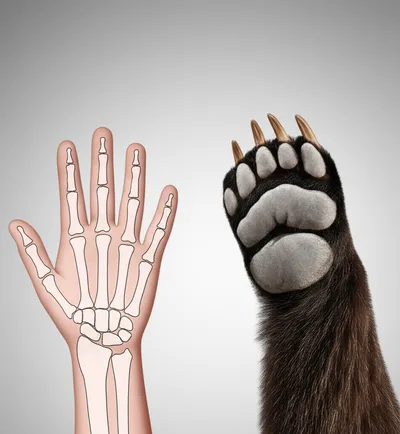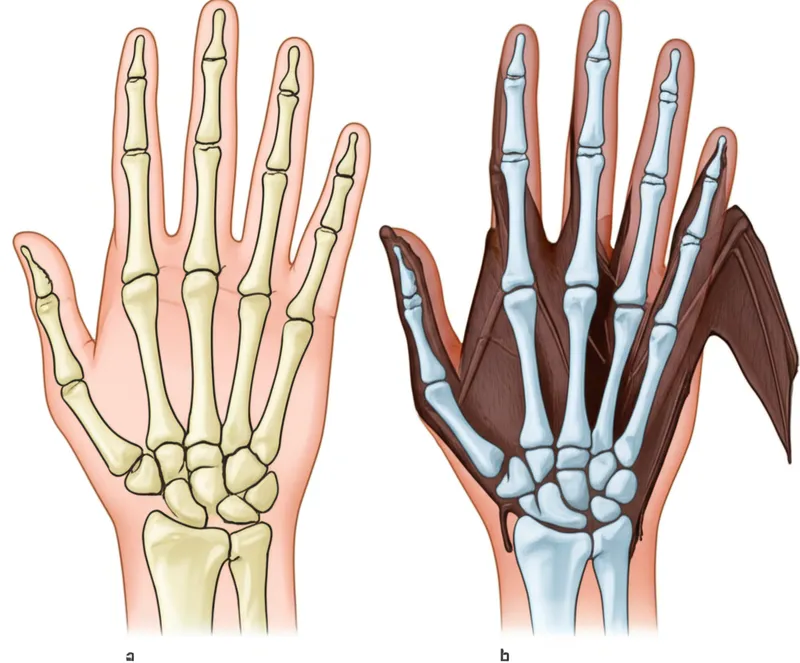

noun🔗Share同源物, 同系物 Something homologous; a homologous organ or part, chemical compound or a chromosome.""In our biology class, we learned that a bat's wing and a human arm are considered homologues because they share a similar bone structure inherited from a common ancestor." "在我们的生物课上,我们学到蝙蝠的翅膀和人类的手臂被认为是同源器官,因为它们拥有相似的骨骼结构,这些结构是从共同祖先那里继承下来的。biologychemistryanatomyorganmedicinesciencebiochemistrystructurepartChat with AIVocabulary GamePractice Reading
noun🔗Share同源词, 对应词 A word shared by two languages or dialects."Many English and French words are homologues, such as "hotel" and "hôtel," making it easier for English speakers to learn French vocabulary. "英语和法语之间有很多同源词,比如英语的 "hotel" 和法语的 "hôtel",这使得说英语的人更容易学习法语词汇。languagelinguisticswordChat with AIVocabulary GamePractice Reading
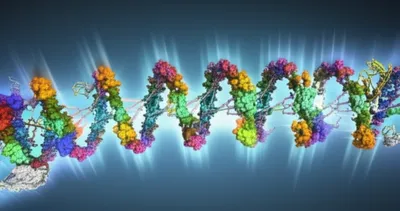
noun🔗Share同源序列,同源物 One of a group of similar DNA sequences that share a common ancestry."Because the two genes share significant sequence similarity and perform similar functions in different species, scientists believe they are homologues, descended from a common ancestral gene. "由于这两个基因序列具有显著的相似性,并且在不同物种中执行相似的功能,科学家们认为它们是同源基因,来源于一个共同的祖先基因.biologybiochemistryorganismgroupscienceChat with AIVocabulary GamePractice Reading
noun🔗Share同系物, 同源物 A member of a homologous series"Here are the first four alkanes in the homologous series: methane, ethane, propane, and butane. Thus, butane and propane are homologues. "以下是同系列烷烴中的前四個:甲烷、乙烷、丙烷和丁烷。因此,丁烷和丙烷是同系物。chemistrycompoundsubstanceChat with AIVocabulary GamePractice Reading