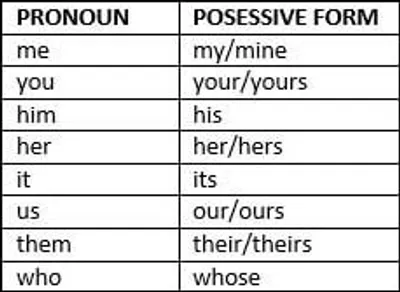
noun 다운로드 🔗공유 소유격 (grammar) The possessive case. Examples : "The possessive case of the word "student" is "student's". " 단어 "student"의 소유격은 "student's"입니다. grammar language linguistics AI와 채팅어휘 게임독해 연습
noun 다운로드 🔗공유 소유격 (grammar) A word used to indicate the possessive case. Examples : "The word "hers" is a possessive that shows ownership. " 단어 "그녀의 것"은 소유권을 나타내는 소유격입니다. grammar language linguistics AI와 채팅어휘 게임독해 연습
adjective 다운로드 🔗공유 소유의, 소유격을 나타내는 Of or pertaining to ownership or possession. Examples : "The student was very possessive of her new notebook, refusing to let anyone else borrow it. " 그 학생은 새 공책을 매우 소유하려 했고, 다른 사람에게 빌려주는 것을 거부했다. property law business AI와 채팅어휘 게임독해 연습
adjective 다운로드 🔗공유 소유의 (grammar) Indicating ownership, possession, origin, etc. Examples : "Here are a few example sentences that fit your criteria: * "The dog wagged its tail, a possessive gesture towards its favorite toy." * "The title uses the possessive form of a noun." " 다음은 귀하의 기준에 맞는 몇 가지 예시 문장입니다: * "개는 꼬리를 흔들며, 가장 좋아하는 장난감에 대한 소유의 제스처를 취했다." * "제목은 명사의 소유격을 사용합니다." grammar language AI와 채팅어휘 게임독해 연습
adjective 다운로드 🔗공유 소유욕이 강한, 소유하는 Unwilling to yield possession of. Examples : "He is very possessive of his car." 그는 자신의 차에 대해 소유욕이 매우 강하다. attitude character mind emotion human AI와 채팅어휘 게임독해 연습