
adjunction
Meanings

Examples :
Adjonction
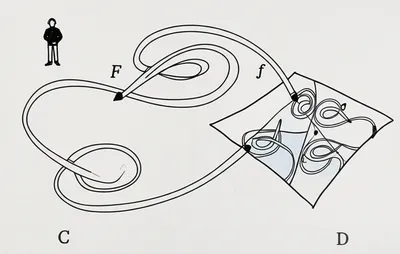
Given a pair of categories \mathcal{C} and \mathcal{D}: an anti-parallel pair of functors F:\mathcal{C}\rightarrow \mathcal{D} and G:\mathcal{D}\rightarrow \mathcal{C} and a natural transformation \eta:\mbox{id}C \rightarrow GF called “unit” such that for any object A \in \mathcal{C}, for any object B \in \mathcal{D}, and for any morphism f:A\rightarrow GB, there is a unique morphism g:FA\rightarrow B such that Gg \circ \etaA = f. (Note: there is another natural transformation called “counit” as well but its existence may be derived by theorem.) The pair of functors express a similarity between the pair of categories which is weaker than that of an equivalence of categories.
Examples :
"The professor explained the concept of adjunction between two mathematical structures using examples from group theory and linear algebra, showing how it establishes a formal connection between them. "
Le professeur a expliqué le concept d'adjonction entre deux structures mathématiques en utilisant des exemples tirés de la théorie des groupes et de l'algèbre linéaire, montrant comment cela établit une connexion formelle entre elles.
Related Words

connection noun
/kəˈnɛkʃən/
Connexion, liaison
"The connection between the two classrooms was established by installing a new phone line. "

transformation noun
/ˌtɹæns.fə(ɹ)ˈmeɪ.ʃən/ /ˌtɹæns.fɔɹˈmeɪ.ʃən/
Transformation, métamorphose

categories noun
/ˈkætɪɡ(ə)ɹiz/ /ˈkætəˌɡɔɹiz/
Catégories, classes






equivalence noun
/ɪˈkwɪvələns/
Équivalence