
adjunction
Meanings

Examples :
Adjungiertheit, Adjunktion
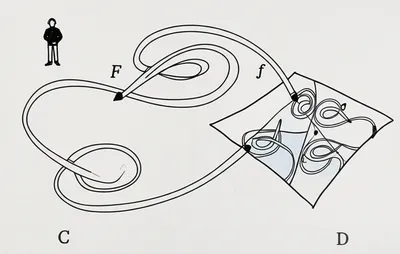
Given a pair of categories \mathcal{C} and \mathcal{D}: an anti-parallel pair of functors F:\mathcal{C}\rightarrow \mathcal{D} and G:\mathcal{D}\rightarrow \mathcal{C} and a natural transformation \eta:\mbox{id}C \rightarrow GF called “unit” such that for any object A \in \mathcal{C}, for any object B \in \mathcal{D}, and for any morphism f:A\rightarrow GB, there is a unique morphism g:FA\rightarrow B such that Gg \circ \etaA = f. (Note: there is another natural transformation called “counit” as well but its existence may be derived by theorem.) The pair of functors express a similarity between the pair of categories which is weaker than that of an equivalence of categories.
Examples :
"The professor explained the concept of adjunction between two mathematical structures using examples from group theory and linear algebra, showing how it establishes a formal connection between them. "
Der Professor erklärte das Konzept der Adjungiertheit zwischen zwei mathematischen Strukturen anhand von Beispielen aus der Gruppentheorie und der linearen Algebra und zeigte, wie es eine formale Verbindung zwischen ihnen herstellt.
Related Words

connection noun
/kəˈnɛkʃən/
Verbindung, Anschluss
"The connection between the two classrooms was established by installing a new phone line. "
Die Verbindung zwischen den beiden Klassenzimmern wurde durch die Installation einer neuen Telefonleitung hergestellt.

transformation noun
/ˌtɹæns.fə(ɹ)ˈmeɪ.ʃən/ /ˌtɹæns.fɔɹˈmeɪ.ʃən/
Verwandlung, Umwandlung








equivalence noun
/ɪˈkwɪvələns/
Äquivalenz, Gleichwertigkeit